Indoor Signage for Offices, Hospitals, Factories and Retail Spaces
November 16, 2026
Think about the last office you visited for a meeting. You probably don’t remember the carpet or the chairs. But you might remember the logo behind the reception desk, or the awkward few minutes you spent hunting for the right floor because nothing pointed the way. That’s indoor signage doing its job, or failing.
Most owners treat signs as an afterthought, something to sort out a week before opening. It usually shows. In this blog, we’ll cover how indoor signs shape first impressions, which materials suit which spaces, how to brand a corporate office, why safety boards matter, and what to check before ordering. Whether you run a clinic in Siliguri, a factory near Durgapur, or a showroom in Newtown, the basics are the same.
Get Custom Indoor Signage Solutions – Request a Free Quote Today! →
How Indoor Signage Shapes a Business’s First Impression
People decide fast. Within seconds of walking in, a visitor has formed a rough opinion of your business, and a lot of it comes from what’s on the walls. A clean logo under good lighting says you’re organized. A peeling vinyl, a name board with a letter missing, or three different fonts on three different doors says the opposite, however good your service is.
That’s why indoor business signage deserves a proper line in the budget. It’s often the first physical thing a client reads, well before your brochure. A bank’s service-desk board builds a little trust. A calm, readable sign in a hospital eases nerves. A lit brand wall in a showroom makes the shelves in front of it look pricier.
Consistency does more than any single fancy piece. If the lobby uses one shade of blue and the corridor boards use another, visitors may not notice consciously, but they feel something is off. Good indoor branding solutions treat the whole interior as one piece: same colours, same typeface, same logo placement from the entrance to the pantry door.
Interior signage matters for your own people too. Staff look at these walls eight hours a day. Values printed well on a feature wall, or clear department boards, quietly tell them the company has its act together.
Indoor Wayfinding Signage: Helping Visitors Find Their Way
Ever walked around a big hospital looking for one particular ward while every corridor looked the same? Wayfinding is the practical side of indoor signage, and it affects visitors more than owners expect.
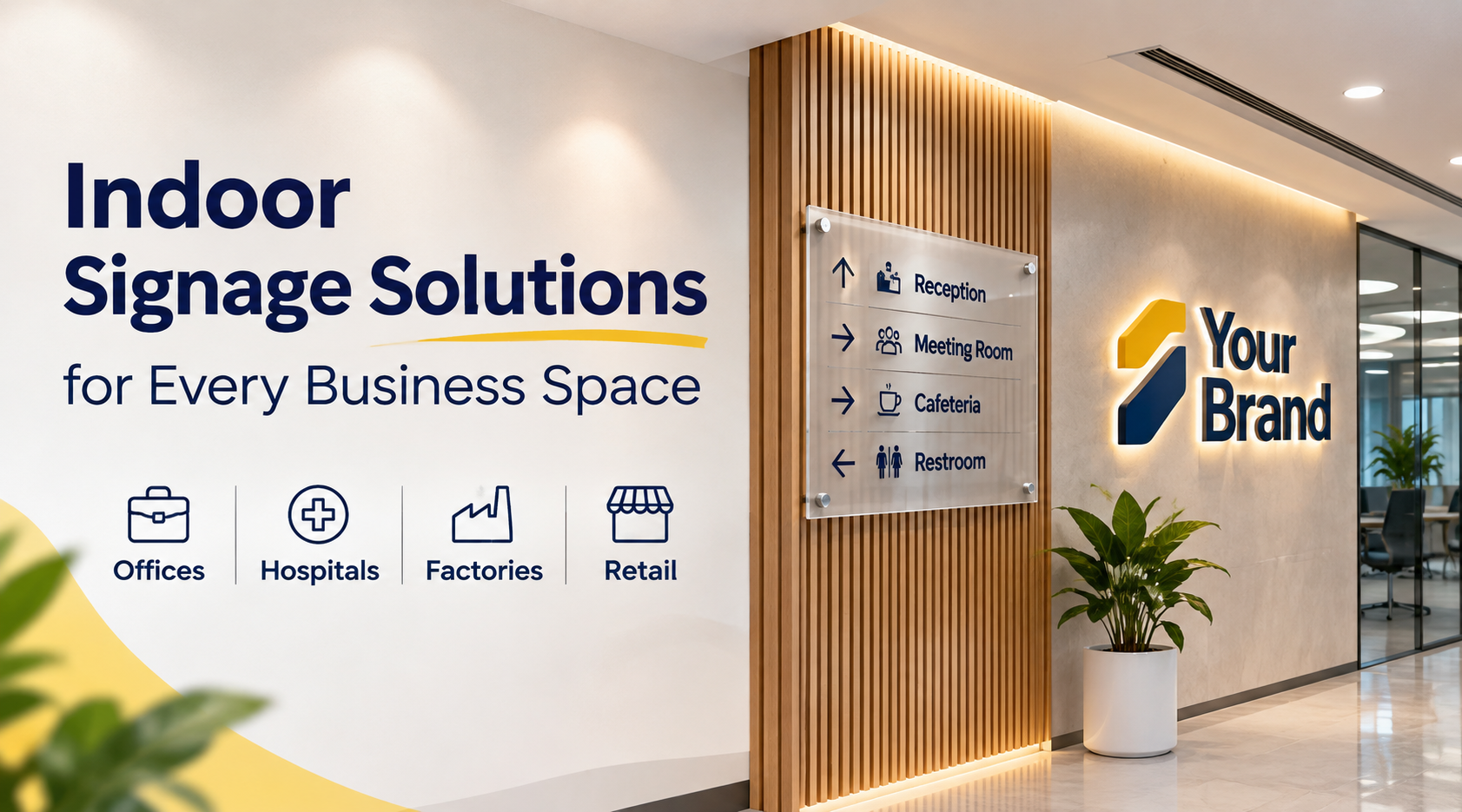
A good system answers three simple questions at every turn: where am I, where do I need to go, and which way now. Floor directories, door plates, room numbers, arrows, and department names all work together to answer them.
A few rules hold up in almost every building. Keep each message short, one idea per board. Use strong contrast so the text can be read from a distance. Put signs where people actually have to make a decision, such as junctions, lift lobbies and staircases, rather than wherever a wall happens to be free. Use the same icons and arrow style throughout. And mount them at a sensible height, somewhere around 1.5 metres.
Nowhere does this matter more than indoor signage for shopping malls, where hundreds of people try to find a store, a washroom or the food court in a few minutes. It’s just as important in multi-tenant towers, where clear indoor signs for commercial buildings save the front desk from answering the same question fifty times a day.
One more tip: plan for change. Tenants move, and departments get reshuffled. Boards with replaceable inserts let you update a name without redoing the whole system.

Choosing the Right Indoor Signage Materials
There’s no single winner here. The right material depends on the space, the budget, and the look you want. Here’s how the usual options compare.
Acrylic is the everyday favourite for offices and showrooms. Acrylic indoor signage is smooth, comes in plenty of colours and thicknesses, and cuts cleanly into letters and layered logos. It’s light, easy to wipe down, and looks sharp on reception walls and name plates. The downside is that it scratches if handled roughly, so it suits controlled interiors better than a rough factory floor.
Aluminium is light, strong, and doesn’t rust. It works well for directional boards, department plates and large panels. With powder coating or a brushed finish, it looks modern without costing much. For busy corridors, it holds up well.
Stainless steel is what you choose when the entrance needs to feel premium. Brushed, mirror, and gold finishes look great in hotel lobbies, corporate headquarters, and hospital entrances. It handles wear and cleans easily, though it sits at the higher end of the budget.
Vinyl graphics are the most flexible and affordable. They’re used for glass branding, wall murals, floor graphics, and frosted film on meeting rooms. Since vinyl can be replaced without major work, it suits promotions and short campaigns. For long-term use, don’t go cheap on the film, because low-grade vinyl fades and lifts at the edges.
Illuminated signage keeps your brand visible even in dim light. LED letters, light boxes and backlit panels suit retail stores, reception areas and food courts. The upfront cost is higher, but the impact is hard to match, and modern LEDs use very little power.
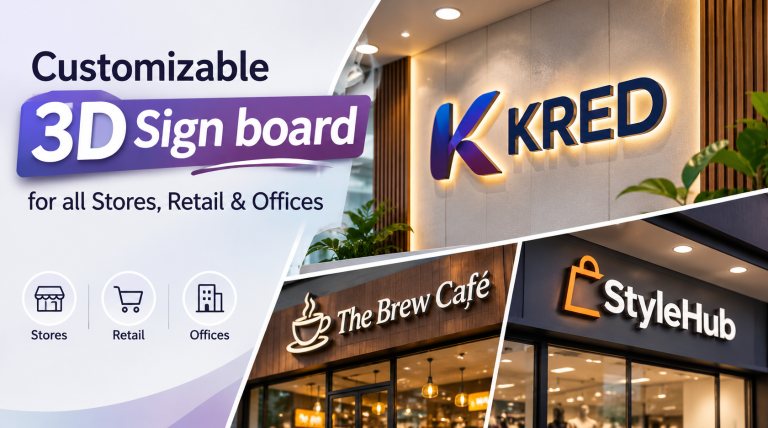
In real projects, materials often get mixed. A reception wall might carry stainless steel letters over an acrylic base, while corridors use aluminium boards and meeting rooms get frosted vinyl. A good supplier helps you combine indoor signage materials so the result looks planned, not patched together. That’s how custom indoor signs end up feeling like they belong to the building.
Indoor Branding Ideas for Corporate Offices
If you’re planning an office refresh, a few ideas consistently work.
Feature walls. One well-designed wall behind reception can carry your logo, tagline or a bold brand graphic. It’s usually the most photographed corner of the office, so it earns the spend.
Company timelines. A wall showing milestones, launches, and growth tells visitors how far you’ve come. It builds credibility and gives long-serving staff something to be proud of.
Mission and values graphics. Values buried in a handbook rarely get read. Put short phrases on the wall in clean typography, and people see them every day.
Reception logos. Dimensional letters in acrylic, steel, or an illuminated format give your name real presence. Soft lighting around them makes the effect stronger.
Pillar branding. Pillars in open-plan offices are usually ignored. Wrapping them with graphics or department names turns an awkward structure into a design feature.
Meeting room graphics. Frosted films, room names, and small brand touches make meeting spaces look finished. They also add privacy without heavy partitions.
All of this sits under office wall branding and the wider idea of corporate office signage. The goal isn’t decoration for its own sake. It’s to make the workplace reflect who you are so clearly that a visitor gets it within a minute. Companies asking for custom indoor signage for businesses often find that one unified plan beats a pile of one-off boards, both in looks and in cost.

Safety and Compliance Signage for Workplaces
Branding gets attention, but safety signs protect people. In factories, warehouses, and hospitals especially, the right sign in the right place can prevent an accident.
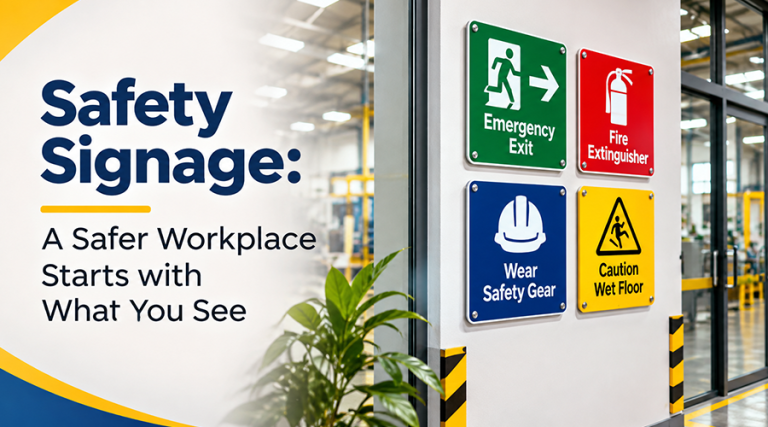
The usual categories include caution signs for wet floors, overhead hazards, and live electrical areas, and PPE instructions telling workers to wear helmets, gloves, masks, or safety shoes before entering. Emergency exit signs should show clear escape routes, ideally in photoluminescent material that stays visible when the power goes. Restricted-area signs mark control rooms and machinery zones. Fire safety indicators point to extinguishers, hose reels, alarm points and assembly areas. In warehouses, notices cover load limits, forklift paths, aisle numbers and stacking rules.
Visibility comes first. A sign that’s too small, mounted too high or hidden behind equipment might as well not exist. Standard colours, recognised symbols and bold text let workers understand the message at a glance, even in a hurry. Placement comes next. Put the sign close to the hazard and at a height people naturally look. Exit routes need marking at every turn, not just at the final door.
What Should Businesses Check Before Ordering Indoor Signage?
A little planning saves a lot of rework. Before you place an order with any indoor signage manufacturer, go through these points.
Start with site measurements. A sign that’s a few centimetres off can look awkward or simply not fit, so insist on an on-site survey instead of relying only on a floor plan.
Then comes artwork approval. Always check a digital proof before production. Look at spellings, logo versions, colours and spacing. Fixing a mistake on screen costs nothing; fixing it after cutting costs a lot.
Think about material selection for the environment. Humid areas, heavy-traffic corridors and rooms with strong sunlight all call for different choices.
Look at the lighting as well. Glossy surfaces throw back glare under ceiling lights, and backlit boards need proper power points planned.
Decide the mounting method. Wall-mounted, ceiling-hung, standoff, floor-standing, and glass-fixed signs each need a different approach, and the wall type matters too, since drywall, brick, and glass behave differently.
Agree on the installation schedule early. If your office is already running, many teams prefer after-hours or weekend work to avoid disruption.
Finally, coordinate with your office fit-out. If you’re renovating, bring the signage vendor in early. Electrical points, false ceilings, and wall finishes all affect how signs are fixed, and last-minute changes are the most common reason for delays.
A reliable custom signage company will walk you through all of this. Choosing one that handles indoor signage installation along with design and production keeps responsibility in one place, so nobody can pass the blame around.
Why Choose Riot Color India for Indoor Signage
If you’re looking for a partner to help you with the design, manufacturing and fitting process across multiple sites, Riot Color India can offer years of experience within the industry. We have everything covered under one roof, so you don’t have to worry about the quality, cost, or timeframes, as we do it all in-house.
The team has solid expertise in B2B industries and works with offices, hospitals, factories, retail brands, hotels, and educational institutions. An experienced design team builds concepts around your brand guidelines, and a professional installation crew handles the on-site work neatly and on schedule. That pairing matters for corporate branding, where one small inconsistency can spoil the whole look.
Multi-location work is another strength. Whether you need the same commercial indoor signage rolled out across several branches or a single flagship installation, Riot Color India serves prime locations and major cities including Kolkata, Newtown, Howrah, Siliguri, Asansol, Durgapur, Guwahati, Darjeeling, Bhubaneswar, Patna, Ranchi, Jamshedpur and more. If you’re searching for professional indoor signboard manufacturers and indoor signage design and installation from a single source, that’s a real convenience.
Indoor Signage for Different Spaces
Every space has its own priorities, so one approach rarely fits all.
In offices, focus on reception branding, department boards, meeting room plates and values graphics. Well-planned indoor signage solutions for offices keep the workplace organised and on brand.
In hospitals, clarity comes first. Large, simple wayfinding boards, calm colours, clear ward numbers and visible emergency markings help patients and families move with less stress.
In factories, durability and safety lead. Heavy-duty boards, floor markings, PPE reminders, machine labels and zone indicators are standard.
In retail, looks drive sales. Indoor signage for retail stores covers brand walls, category boards, price displays, and illuminated logos that draw shoppers toward key products. Smartly placed indoor advertising signs can push featured items without any extra staff effort.

Final Thoughts
Good indoor signage does three things at once: it strengthens your brand, guides people through the space, and keeps them safe. Getting there takes the right materials, careful design, accurate measurements, and skilled installation.
If you’re setting up a new office, upgrading a store or opening a factory, start with a clear brief and a partner who can handle every stage. Riot Color India offers exactly that, with the experience, in-house capability, and regional reach to turn your interior into a space people remember. Book a site visit, ask for a tailored quote, and see how the right signs change the way your business is seen.
Frequently Asked Questions
What is indoor signage?
An indoor sign plays an important role; it means that when you are inside any premises, you should have the right kind of signage for better visibility and attraction. Indoor signs are placed inside buildings, covering safety signs, wayfinding, and even promotional messages.
How much does custom indoor signage cost?
It depends on size, material, lighting, and design complexity. A vinyl graphic costs far less than illuminated stainless steel letters. A quote after a site visit is the best way to get a realistic number.
How long does it take to make and install indoor signs?
Simple jobs can be done in a few days. Larger or illuminated installations usually take a couple of weeks, depending on approvals and how ready the site is.
Which material is best for indoor signs?
Acrylic is a good choice for office and showroom signage, aluminium for corridors and high-traffic areas, stainless steel if you require something more premium, vinyl for versatile, cost-effective graphics.
Can one company handle design, manufacturing and installation?
Yes. Riot Color India can handle signage design, in-house manufacturing, and professional installation . We provide a complete solution that a business branding needs.
Can you print large graphics for walls and glass?
Yes. Professional indoor sign printing covers wall murals, window films, floor graphics, and large-format panels with sharp colour and clean finishing.