Why Wayfinding Signage Is the One Thing Every Growing Business Overlooks
September 28, 2026
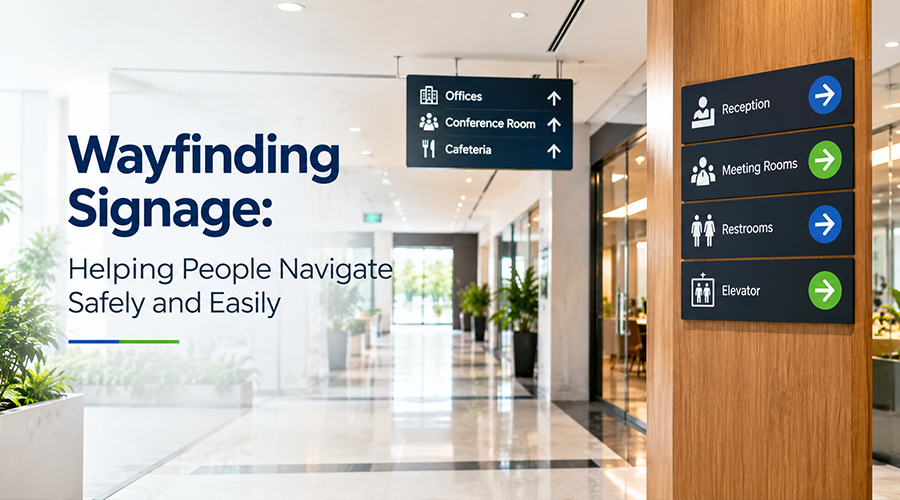
Walk into any large hospital, corporate park, or shopping complex and pay attention to the first thirty seconds. That’s usually all it takes to tell whether a space has been designed with people in mind or not. If you’re glancing around looking for an arrow, a board, or anything that tells you where to go, you’ve just experienced what happens when wayfinding signage is missing or done poorly. And if you found your way without even thinking about it, that’s good signage doing its job so quietly you didn’t notice it at all.
That’s really the whole point of wayfinding. It’s not there to be admired. It’s there to be useful.
The Problem Most Spaces Don’t Realize They Have
Here’s the thing about buildings, campuses, hospitals, and business parks: the people who design them know the layout inside out. They walk those corridors every day. But the people using the space for the first time, a visitor, a new employee, a patient, a delivery agent, don’t have that advantage. They’re relying entirely on cues around them to understand where they are and where they need to be.
Without proper Directional sign board , confusion sets in fast. People stop strangers to ask for directions. They wander into restricted areas by accident. They show up late to meetings because they couldn’t find the right block. In hospitals, this isn’t just inconvenient, it can genuinely delay someone getting to the care they need. In corporate campuses, it creates a bad first impression before a client has even sat down for their meeting.
Good signage solves all of this before it becomes a problem.
What Wayfinding Signage Actually Covers
A lot of people hear “signage” and picture a single board with an arrow on it. In reality, wayfinding is a whole system. It includes entrance signs that tell people they’ve arrived at the right place, directional boards placed at every decision point where someone might need to choose a path, floor and department indicators inside buildings, parking and zone markers, safety and emergency signage, and digital displays where needed.
Every directional sign board in that system has to work together. If one board says “Block A” and the next one three hundred meters ahead uses different terminology or a different color code, people get confused all over again. Consistency is what makes a signage system actually function, not just look nice on installation day.

Types of Wayfinding Signage You’ll Come Across
While you are in the area you may find different types of wayfinding solutions that help in many forms.
- Entrance/Identification signage : It indicates your arrival at the right location of the building or facilities.
- Directional signage – Arrows that guide pedestrians towards the right zone and areas.
- Informational signage – Layouts, directions, maps and accurate signs that provide information to guide all.
- Floor/department indicators : Each sign is necessary for pointing to specific departments, wings or rooms.
- Parking/zone markings Boards for the help of traffic and guests to figure out areas where they’re not supposed to park.
- Safety and emergency signs : Board for indicating exit/assembly points, fire assembly location/hazard zone- this a legal mandatory that every workplace must abide by.
- Interactive digital wayfinding screens For large campuses with multiple exits, digital displays can give users real-time, turn-by-turn direction.
- ADA/accessibility signage. Boards to assist physically challenged in moving across an area.
Why This Matters More in 2026 Than It Did a Few Years Ago
Spaces have gotten bigger, busier, and more layered. Corporate parks now house multiple companies under one roof. Hospitals have expanded into multi-building campuses with specialty wings scattered across different floors. Retail spaces have grown into massive multi-level complexes. Even manufacturing plants have added visitor zones, admin blocks, and separate production units that didn’t exist a decade ago.
As spaces grow, the room for confusion grows right along with them. A single reception desk telling people where to go simply doesn’t scale once you’re dealing with a campus spread across several acres or a hospital with a dozen departments. This is exactly why more businesses across industries are now treating signage as part of their core infrastructure planning instead of something to figure out after construction wraps up.
Who Actually Needs This
This is where a lot of people assume wayfinding is only for hospitals or malls. It isn’t. Corporate offices need it so employees and visitors move around without constant confusion. Manufacturing and industrial units need it for safety compliance as much as convenience, especially across large factory floors. Educational campuses need it so new students and parents aren’t lost on day one. Residential townships and gated communities need it so deliveries, guests, and residents all find their way without a dozen phone calls to security. Retail and hospitality spaces need it because a confused customer is rarely a happy one.
If people are moving through your space, whether that’s a hundred people a day or ten thousand, signage isn’t optional. It’s part of how space functions.
The Role a Good Signage Partner Plays
The challenge begins when a signage project moves from design to production and installation. Designing signage is one thing. Manufacturing it to withstand years of outdoor exposure, sun, rain, dust, is another. Printing it with sharp, consistent branding across dozens or hundreds of boards is yet another challenge. And then there’s installation, which sounds simple until you’re coordinating it across multiple sites, sometimes in different cities, all on tight timelines.
This is exactly the gap Riot Color India fills for businesses that don’t want to juggle four different vendors for one signage project.
Working with an in-house production unit changes the entire experience. Instead of a design getting approved and then bounced between a printer, a fabricator, and an installation crew, everything moves under one roof. That means fewer delays, tighter quality control, and far less back-and-forth trying to explain your brand guidelines to three separate teams who’ve never spoken to each other.
Big industries don’t take chances on signage partners without a track record, and that’s really the point. Businesses that operate at scale, hospital chains, manufacturing groups, IT parks, and large retail brands, need a partner who’s already proven they can deliver consistently, not one still figuring things out on their first big project.

One Project, Multiple Cities
If your business operates across more than one location, and most growing businesses do, your signage needs a partner who can actually show up on-site everywhere you operate, not just ship boards and leave installation to whoever’s locally available. Multi-location installation capability is one of those things that sounds like a minor detail until you’re the one trying to coordinate five installations across five cities without any single point of contact managing quality.
This is where having a partner who serves major cities across the eastern and northeastern region genuinely matters, think Kolkata, Newtown, Howrah, Siliguri, Asansol, Durgapur, Guwahati, Darjeeling, Bhubaneswar, Patna, Ranchi, Jamshedpur, and beyond. Whether it’s a single corporate office in one city or a chain of hospitals spread across four states, the process should feel identical everywhere: same design language, same production quality, same installation standards.
Why the “One-Stop” Approach Actually Saves Time and Money
Businesses often start with the idea of handling design in-house, outsourcing manufacturing, hiring a separate printer, and then bringing in a local contractor for installation. On paper, this feels like it gives more control. In practice, it usually creates more friction, more revisions, more miscommunication, and more chances for something to go wrong between handoffs.
A complete branding solution, covering design, manufacturing, printing, and installation under one process, removes most of that friction. When one team owns the entire journey from concept to the final board being mounted on a wall, accountability doesn’t get lost somewhere between three different companies pointing fingers at each other. Riot Color India approaches signage this way, treating it as one continuous project rather than four separate vendor relationships stitched together.
Serving Every Major Industry, Not Just One Niche
Signage needs look different depending on the industry, and a good partner understands that instead of applying the same template everywhere. A hospital needs clear, calm, easy-to-read boards that reduce stress for patients already dealing with enough of it. The factory needs sturdy, all weather boards that can tolerate the outside industrial environment while maintaining a clear safety message. The corporate park needs stylish, branded boards that represent the businesses. Retail spaces need signage that guides footfall while still looking visually appealing.
Serving all major industries means understanding these differences rather than pushing a one-size-fits-all board and calling it done. It’s the difference between signage that technically exists and signage that actually improves how people experience a space.
What Good Wayfinding Actually Feels Like
The best compliment any signage system can get is that nobody talks about it. That’s not because it’s forgettable, it’s because it worked so well that people never had to think twice about where they were going. Every directional sign board did its job at exactly the right moment, every entrance sign confirmed they’d arrived at the right place, and every turn felt obvious instead of confusing.
That’s the standard worth aiming for, whether you’re planning signage for a single office building or a sprawling multi-city operation.
Small Details People Notice Without Realizing It
There’s a quieter side to wayfinding that rarely gets discussed but makes a real difference. Font size matters more than most people assume, boards placed too high or printed too small get ignored by people walking at a normal pace. Color coding matters too, using distinct colors for different blocks, floors, or zones lets people navigate almost instinctively once they’ve seen it once. Even the material used changes how a board reads in different lighting, a glossy finish under harsh sunlight can wash out text, while a matte finish holds up better outdoors.
None of these details are dramatic on their own, but stacked together, they decide whether a signage system feels effortless or frustrating. A rushed installation with mismatched fonts and inconsistent colors ends up looking like an afterthought, even if the individual boards were well designed. This is usually where the difference between a vendor and an actual signage partner shows up, in the details nobody asks about until they’re missing.
Planning Signage Alongside Construction, Not After It
One mistake a lot of businesses make is treating signage as the very last item on a long construction checklist. By the time the building is ready and everyone’s focused on move-in dates, signage gets rushed, and rushed signage tends to be inconsistent, mismatched, or missing entirely in key spots.
Ideally, wayfinding planning starts alongside the architectural layout, not after it. Knowing where corridors branch, where lifts and staircases sit, and where visitor footfall will be heaviest helps design a signage plan that actually matches how people will move through the space, rather than boards added wherever there happened to be an empty wall left over.
Businesses that plan this way tend to spend less in the long run too. Retrofitting signage after a space is already operational usually costs more than getting it right the first time, simply because installation becomes trickier around a building that’s already in daily use.

Bringing It All Together
Good wayfinding signage isn’t about scattering a few boards around a building and hoping for the best. It’s a system, thought through carefully, manufactured to last, installed with precision, and consistent enough that people trust it without even realizing they’re relying on it. Get it right, and visitors, employees, and customers move through your space with confidence. Get it wrong, and every interaction with your brand starts with confusion instead of clarity.
If your business is expanding, adding locations, or simply realizing your current signage isn’t keeping up with how big you’ve grown, it might be time to treat wayfinding as the infrastructure priority it actually is, not an afterthought squeezed in after everything else is built.
Riot Color India has spent years helping businesses across industries get this right, from single-site offices to multi-city operations spanning hospitals, factories, and corporate campuses. Sometimes the most important part of a building isn’t the building itself. It’s how easily people can find their way through it.
Frequently Asked Questions:
What exactly does wayfinding signage include?
It covers the full system, entrance signs, directional boards at decision points, floor and department indicators, parking markers, and safety signage, all designed to work together rather than as standalone boards.
Is wayfinding signage only needed for large spaces like malls or hospitals?
Wayfinding signage can be used in any areas for better user experience, better for pedestrians keeping them safe and without confusion one can be at their place. We can see wayfinding signages in offices, malls, factories, campuses, resident areas, gyms etc.
How is a directional sign board different from a regular sign?
A directional signboard directs specifically to guide people to the right direction, pointing towards the path rather than displaying information or branding.
Can signage be installed across multiple cities for one project?
Yes. Riot Color India can do this for you, we do deliver across all major locations and are capable of installing for your projects.
Does Riot Color India provide installations for free ?
Yes. We do provide free installation and delivery for free, even we provide the repair facilities if it’s damaged.
What materials are best for outdoor directional signage?
For outdoor directional signages it depends on what types of materials it’s been used, like premium materials are best because it can withstand all types of weather and can stay in direct sunlight.